The Silent Cost of Ageism: How Australia’s Over 50s Are Really Feeling
By Pete Tsakissiris
Names and identifying details of individuals quoted in this article have been changed or withheld at their request, to protect their privacy while they remain in active job searches.
“Pete, I don’t know who I am anymore.”
I wasn’t expecting those words. We’d started the conversation talking about careers. Within twenty minutes, we were talking about identity.
The person on my screen wasn’t inexperienced. She had spent more than a decade managing complex projects, delivering outcomes on time and mentoring junior colleagues. Yet after hundreds of unanswered job applications, she wasn’t questioning her experience. She was questioning herself.
When the call ended, I sat staring at my screen. It wasn’t the first conversation like that. It wouldn’t be the last.
Over the past few months, through Ovee’s Over 50 Initiative, I’ve spoken with hundreds of experienced Australians looking for work. I expected to hear frustration about applicant tracking systems, automated rejections and a competitive market. Instead, I heard something more confronting: grief. Not grief over losing a job. Grief over losing an identity.
When we launched the Over 50 Initiative, I thought our biggest challenge would be helping experienced professionals become more visible. I was wrong. The biggest challenge has been helping people believe in themselves again. After months, sometimes years, of rejection, many no longer need someone to rewrite their CV. They need someone to remind them that their experience still matters.
“They told me to colour my hair”
One conversation has stayed with me more than most. A man I’d been speaking with paused, then said something I didn’t expect.
“Someone told me I should colour my hair,” he said. “They said I’d have a better chance of getting a job if I looked younger.”
Think about what that advice actually says. Not “let’s talk about your leadership experience.” Not “let’s discuss your skills.” The message was simpler and harder to hear: hide who you are. Hide the grey hair that reflects decades of experience. Hide the very thing that should be valued.
“How do you think that makes me feel?” he asked. I didn’t know what to say, not because I disagreed, but because I couldn’t believe that in Australia today, someone had been told the answer to finding work wasn’t improving their skills. It was hiding their age. No one should have to change their appearance to be considered employable. That isn’t career advice. It’s ageism.
“Get a new email account”
Another person told me they’d been given similar advice, not about their appearance, but about their inbox.
“I was told to get a new email account,” they said. “Because my Hotmail address made me look old.”
It sounds like a small thing. It isn’t. A job seeker was being judged, before a recruiter had read a single line of their CV, on the domain name of their email address. Not their experience. Not their track record. An email provider that has simply been around for a long time.
If a resume can be quietly filtered because of the year an email account was created, it is worth asking how many capable people are being screened out before anyone has actually looked at what they can do.
The phrases they keep hearing
Ask enough experienced job seekers about their interviews and the same phrases start to repeat, almost word for word, regardless of industry or location.
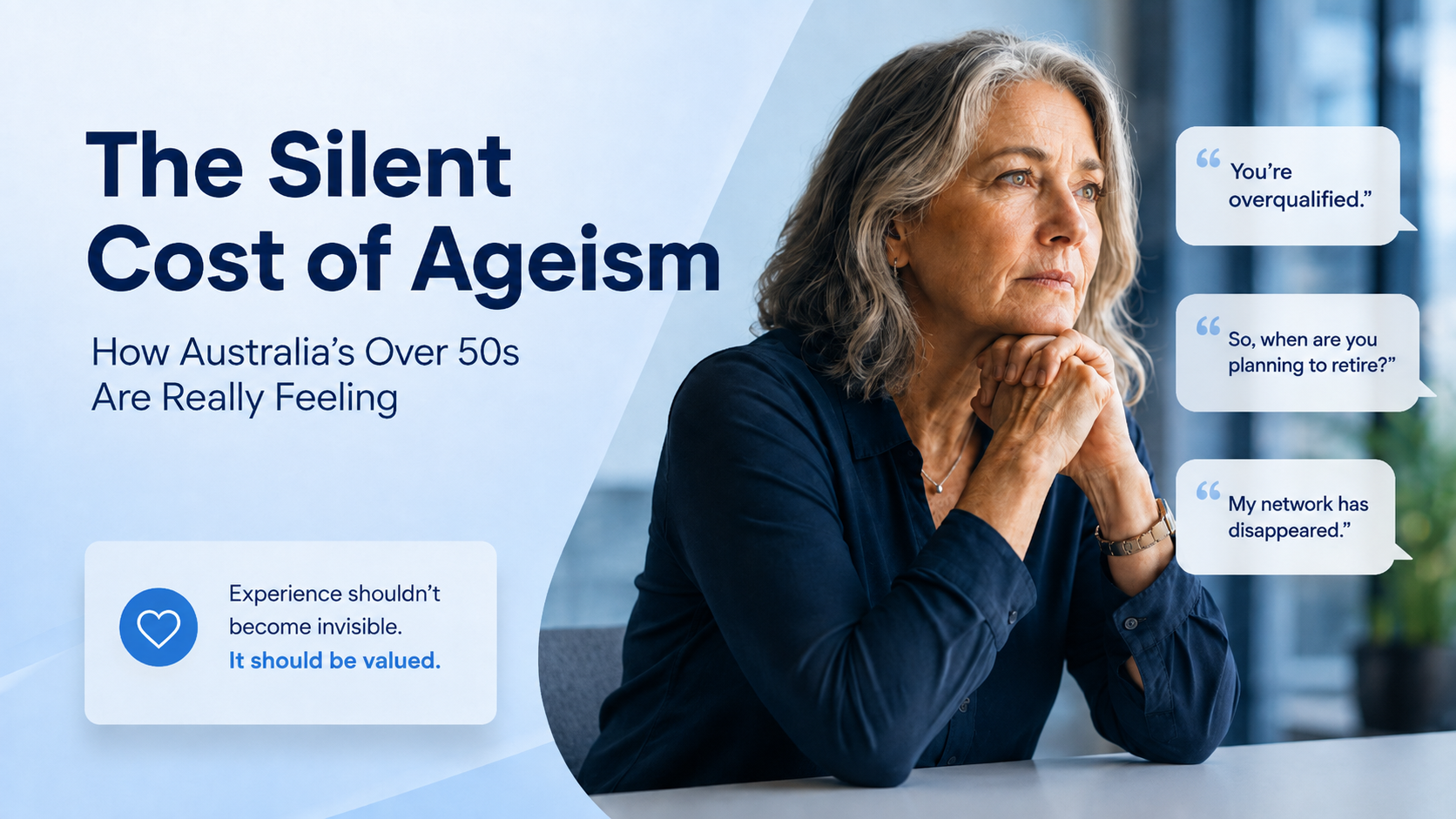
“You’re overqualified.”
“We think you’d get bored in this role.”
“This job might be a bit junior for you.”
And, more often than people expect, a question that has nothing to do with the role at all: “So, when are you planning to retire?”
None of these are stated as objections to skill. They are framed as concern, almost as if the recruiter is doing the candidate a favour. But strip away the framing and the message is the same one running through every story in this article: your experience is not an asset here, it is a liability to be managed. “Overqualified” rarely means a person cannot do the job. It usually means an employer has already decided not to give them the chance to prove it.
A refuge, not a choice
Another project manager told me she’d moved into aged care after a long corporate career. I asked why.
“Because it was the only industry where I didn’t feel judged because of my age,” she said.
She hadn’t changed direction because it was her ambition. She changed because she no longer believed she belonged in the industry where she’d spent decades building her expertise. Aged care became a refuge, not a dream, because it was one of the few sectors where her experience was still recognised.
“I’ve applied for over 200 jobs”
It’s the sentence I hear more than any other, sometimes 150, sometimes 300, often too many to count. When I ask how many interviews have followed, the answer is usually the same: very few. When I ask how many recruiters responded at all, it’s often none. No feedback. No phone call. No explanation.
People tell themselves at first that it’s simply a competitive market. Then weeks become months, and months become a year, and the questions start to change: Am I too old? Has my experience become a disadvantage? Do I have anything valuable left to offer? These aren’t questions asked by people who lack capability. They’re asked by people whose confidence has been worn down by silence, and the silence, more than any single rejection, is what does the damage.
“My network has disappeared”
One man described watching his professional world quietly empty out. His phone once rang constantly: clients, recruiters, colleagues wanting his advice. Now it barely rings at all.
“I feel lonely,” he told me. Not unemployed. Lonely. After thirty years of working alongside people, work is rarely just a pay cheque. It’s community, connection and belonging. When it disappears, people lose far more than income, and for some, the loss settles into something closer to “I feel worthless,” a phrase I’ve now heard more than once, from people who haven’t stopped being capable of contributing, only stopped being given the chance to.
What the research shows
These accounts aren’t isolated impressions. In 2025, the Australian HR Institute (AHRI) and the Australian Human Rights Commission published Older and Younger Workers: What Do Employers Think?, a survey of 138 employers and HR professionals across Australia.
The findings are stark. One in five HR professionals say their own organisation’s recruitment practices negatively impact older workers, an admission from within the profession, not an accusation from job seekers. The same research found that almost one in four HR professionals now classify workers aged just 51 to 55 as “older”, more than double the proportion recorded two years earlier.
Someone in their early fifties, often at the peak of their leadership capability, is now routinely viewed as an older worker. Yet the Age Pension eligibility age in Australia is 67, meaning many people in their fifties still have fifteen to twenty years of productive working life ahead of them. This isn’t only a perception problem. It’s becoming an economic one.
The assumptions don’t hold up
One of the most persistent myths about experienced workers is that they resist change. My conversations suggest the opposite: executives studying artificial intelligence in their sixties, project managers completing cybersecurity qualifications, healthcare professionals mastering new digital systems, people launching new businesses because they still want to contribute. Curiosity, ambition and resilience don’t have an expiry date.
A business problem, not just a social one
Throughout my career, whether leading consulting teams, advising executive leaders or now building Ovee, one lesson has remained constant: when organisations face their hardest problems, they don’t ask for the youngest person in the room. They ask for the person who’s solved something similar before. Experience reduces risk, improves judgement and accelerates decision-making. That’s not sentiment. That’s commercial logic, and it’s exactly what many organisations are unknowingly filtering out of their hiring process.
Why this has become personal
People often ask why Ovee has invested so heavily in the Over 50 Initiative. The answer isn’t technology or recruitment. It’s people, wisdom, leadership, technical and commercial experience, and a simple wish to contribute again. The tears I’ve witnessed don’t motivate me because they’re emotional. They motivate me because they reveal a problem we’ve ignored for too long.
A visibility problem, not an experience problem
Every morning, somewhere in Australia, an experienced professional updates a CV, tailors another application, and clicks submit. Most will never hear another word. Inside that silence, confidence and purpose begin to erode, and good people slowly come to believe they’ve lost their value. They haven’t. We’ve simply stopped seeing them.
We talk constantly about Australia’s skills shortage. Perhaps we’re asking the wrong question. Maybe it isn’t where we’ll find the talent. Maybe it’s why we’ve stopped seeing the talent we already have.
Australia doesn’t have a shortage of experienced people. It has a visibility problem. It’s time we stopped judging people by the year they were born, and started recognising the judgement, resilience and wisdom that experience actually brings.